






© 2006
The translations of titles, articles, books, citations, and statements by scientists may not match the official translations word for word, if such translations exist.
Welcome to the website “Electromagnetic Universe by Rozanov’s,” dedicated to questions of theoretical physics. The site presents a concept within which the four fundamental interactions are interpreted as manifestations of a single one — the electromagnetic (or Coulomb) interaction.
The theory of N.N.Rozanov also includes an explanation of the mechanism of rest mass formation in elementary particles (electron, positron, proton, and antiproton), a description of their structure, as well as new interpretations of a number of controversial issues in modern physics.
One of the key tasks of modern theoretical physics remains the search for a unified model capable of explaining the origin and interconnection of the four fundamental interactions — gravitational, electromagnetic, strong, and weak.
Despite significant theoretical achievements in the fields of quantum field theory and general relativity, to this day there is no universally accepted concept that could serve as a foundation for a unified field theory.
The theory of N.N.Rozanov represents one of the most systematic and accessible attempts to build a semiclassical model of the Universe based on electromagnetic interaction.
To correctly understand the premises and evolution of this theory, it is appropriate to turn to its historical context.
The idea that gravitational interaction might have an electromagnetic nature dates back to the 19th century.
In particular, in 1836, the Italian physicist and mathematician Ottaviano Mossotti proposed a hypothesis according to which gravitational interaction could be regarded as a consequence of an imbalance of forces — the attraction between unlike charges exceeding the repulsion between like ones.
This idea formed the basis of N.N.Rozanov’s manuscript “Semiclassical model of the electromagnetic universe and the unified field theory.”
Ideas of the electromagnetic nature of gravitational interaction have periodically resurfaced within the scientific community, but they have never gained general acceptance. In the 20th–21st centuries, some researchers again returned to the assumption that gravity might be derivative of electromagnetic processes. Nevertheless, such hypotheses remain little-known and are almost never covered in modern popular science literature
The theory of N.N.Rozanov stands out for its accessibility to a wide audience of engineers and technocrats, as well as for having experimental support. More about this can be found in the article “Silence, or Who Benefits From it?” as well as in the description of an experiment where an excess of the electron’s charge over that of the proton was recorded. This result was confirmed in 1972 at the Massachusetts Institute of Technology (see: Physical Review A, Volume 7, Number 4, April 1973. “Neutrality of Molecules by a New Method,” H. Frederick Dilla and John G. King).
Since materials on this experiment have largely disappeared from public information space, a brief summary of its main results is given below.
«Neutrality of Molekules by a New Method.» H.Frederick Dilla and Johng, King).
(Author’s note: The neutron is a composite particle.)
The experiment was conducted using the heaviest gas molecules — sulfur hexafluoride (SF₆). Each molecule contains 146 dyads (the neutron should also be considered a dyadic structure, according to the works of E. Rutherford and J. Chadwick).
The measurements yielded a value of negative excess charge of the molecule (Δq), corresponding to the total charge of all 146 pairs:
|ε| ≤ 1,9 × 10⁻¹⁹(cl).
Thus, the average charge per dyad was:

Some supporters of relativistic theory tend to point out the insignificance of this value, interpreting it as experimental error. However, they often overlook the need to compare it with a fundamental physical constant — the elementary charge (O.N.Rozanov):
|1,602 × 10-19|(cl).
Comparison of the obtained excess charge value with the elementary charge is fundamentally important.
Even if the registered magnitude approaches the limits of experimental sensitivity, it is still comparable in order of magnitude with the fundamental constant — the elementary charge. This indicates that the result cannot automatically be attributed to random fluctuations or measurement noise.
This is precisely O.N.Rozanov’s argument — that the experimentally observed excess of the electron’s charge over the proton’s charge may serve as empirical confirmation of the theoretical model.
Now let us turn to a simple differential equation formulated by engineer N.N.Rozanov.
The essence of his approach lies in comparing the minimal forces of Coulomb and gravitational interactions by introducing into Coulomb’s law a special correction factor — the gravitational coefficient K(g).
The physical meaning of the coefficient K(g), introduced into Coulomb’s law when equating two different minimal fundamental interactions (expressed in newtons, SI), is that it allows one to precisely determine how many times the gravitational force between two protium atoms is weaker than the Coulomb force between the elementary charges — the electron and proton — forming the simplest atom.
Hence, by calculating the value of K(g), one can determine the expected difference in charge values in the “electron–proton” pair of a protium atom, thereby theoretically confirming Ottaviano Mossotti’s conclusion that the excess of the electron–positron charge over the proton–antiproton charge in dyads and antidiyads is approximately:
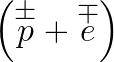 is approximately:



-1,602×10-19(cl) × 9 × 10-19≈ -1,442 × 10-37(cl).
Continuing to one of N.N.Rozanov’s conclusions:
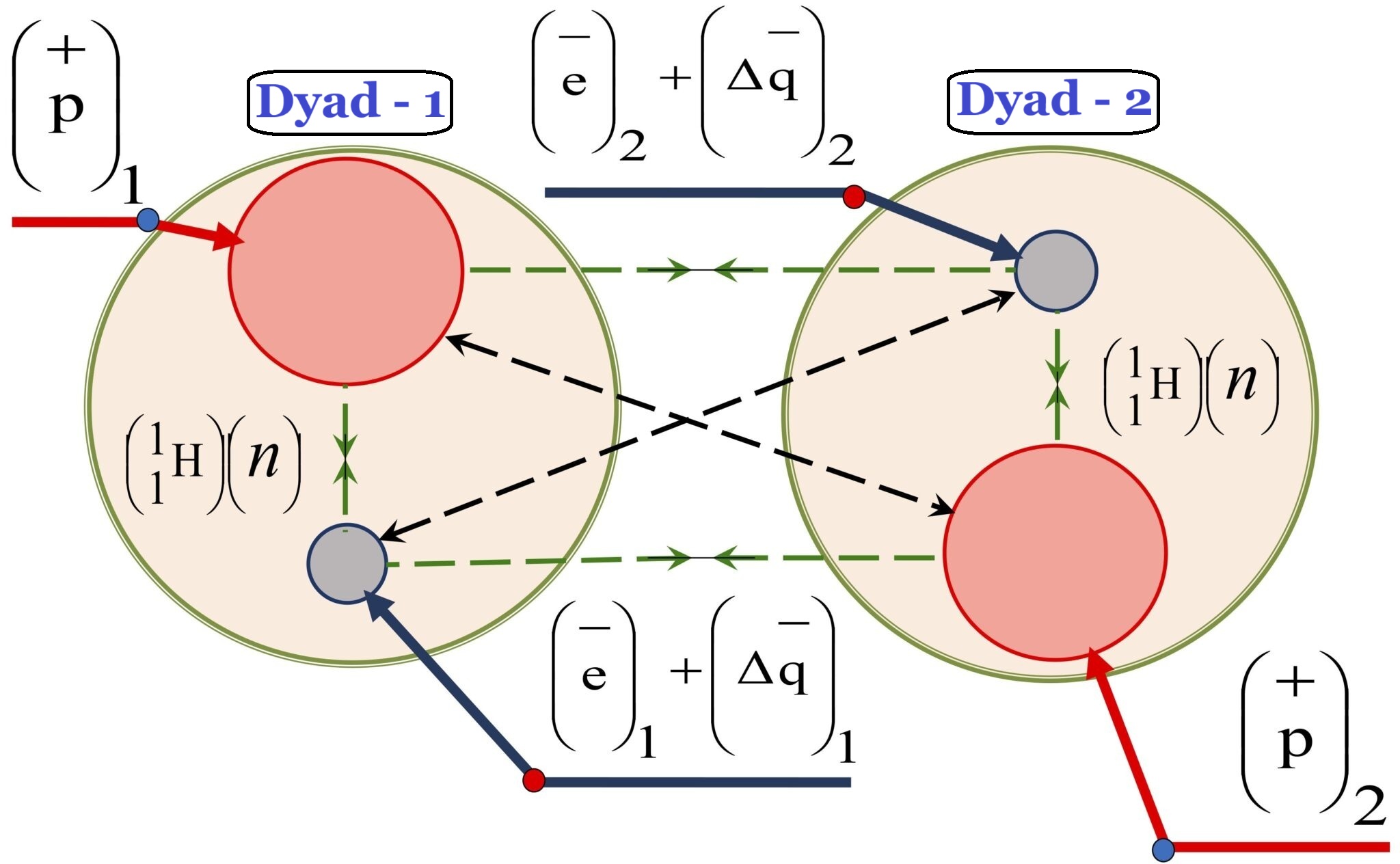
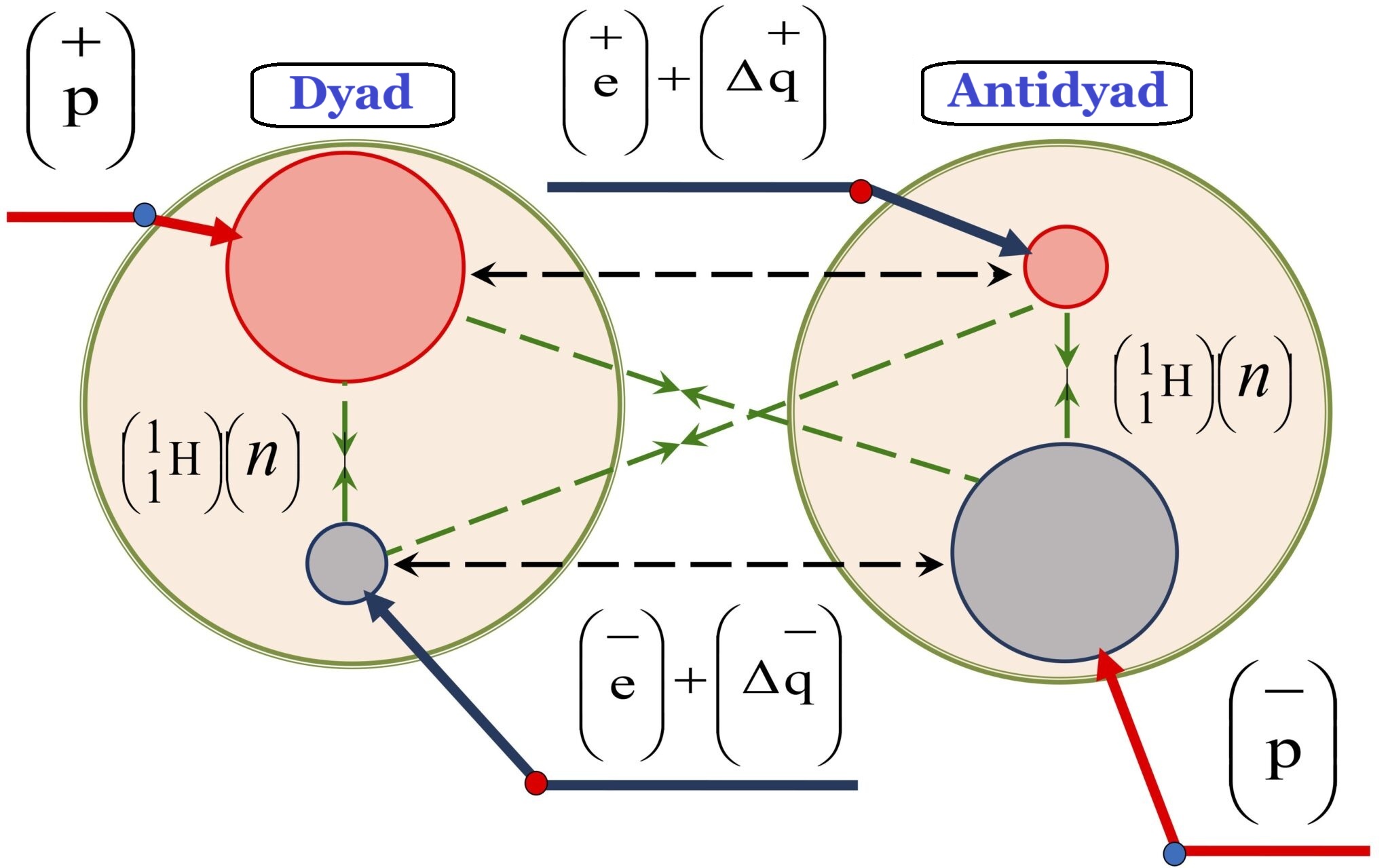
According to his hypothesis, gravitational interaction is in fact a form of Coulomb interaction between dyads or between antidiyads.
The reason for this interaction lies in the excess of the electrodynamic charge of the electron–positron (Δq) over that of the proton–antiproton.
As a result, dyads attract each other, and so do antidiyads, due to a deficit of Coulomb repulsion between nucleons:

At the same time, dyads and antidiyads repel each other, which is explained by a deficit of attraction between nucleons and antinucleons:

The force of such interaction follows Coulomb’s law and is quantitatively expressed through the value (Δq²), previously calculated using the correction factor — the gravitational coefficient K(g).
– Gravity –

– Antigravity –

Summarizing the first part of the preface:
Gravity arises as a consequence of the rotation of electrons around protons.
According to the theorem on the motion of the center of mass, in a proton–electron system both bodies revolve around a common center of gravity, with the electron moving about 1836 times faster than the proton.
Due to this motion, an additional electrodynamic field (by Ampère’s law) arises. In ordinary substance it manifests as negative, and in antisubstance — as positive.
Its magnitude is approximately:
|Δq| ≈ 1,442 × 10-37(cl),
per dyad, and depends on the binding energy between electrons and protons in nucleons.
Next, we briefly consider the key principles and laws of physics on which this work is based.
“Semiclassical model of the electromagnetic universe and the unified field theory” offers an integral vision of the Universe’s structure:
- The authors of this work assert that all fundamental interactions have an electromagnetic nature, and that the laws of electromagnetism govern the microcosm, macrocosm, and ultimately the megacosm.
The fundamental laws of the Universe are:
Heisenberg’s uncertainty principle.
The inverse-square law of Newton–Coulomb–N.N.Rozanov (main author of discovery No. 32-от-11151, dated 24.06.85).

The Virial theorem (R. Clausius).
Nuclear forces are Coulomb forces in which one electron “binds” two or three protons (deuteron, helium-3 nucleus), or two electrons “bind” three or four protons (triton, alpha particle); other “bindings” are extremely unstable.
The generators of substance and antisubstance in the Universe are quasars, which do not possess a gravitational field, since the amount of substance and antisubstance they generate is exactly equal.
Every second galaxy is an anti-galaxy.
Galaxies and anti-galaxies anti-gravitate due to the deficit of attraction between the protons of dyads and the antiprotons of antidiyads.
The inertial masses of matter and antimatter in the Universe are equal:
 – that is, the number of dyads and antidiyads is the same.
- Dear visitors, no registration is required to leave your comment.
- The set of mathematical formulas in the comments is edited in the “LATEX” system. A formula is opened with the word katex [in square brackets] and closed with /katex [in square brackets].
- If your comment contains a link, it is automatically sent to spam for verification. Without links, all comments are published without delay.