






© 2006
Аuthors – Nikolai Nikolaevich Rozanov, Oleg Nikolaevich Rozanov
1. The matter and antimatter of the Universe is born from the “Absolute Nothing” or the astrophysical vacuum (A.P.V.).
2. The Universe consists of absolutely equal amounts of substance and antisubstance (Klein, Alfvén), composed of dyads, and dyads consist of two elementary particles that are born in pairs from the “Absolute Nothing” or the astrophysical vacuum (A.P.V.):
\left({\overset{+}{p}}+{{\overset{-}{p}}}\right) и \left({\overset{-}{e}}+{{\overset{+}{e}}}\right),
in the “D-bodies” of quasars.
3. Based on the electrodynamic theory of gravitation (Mossotti, Weber, Zöllner, Lorentz, Wien, Poincaré, Riemann, Neumann, Rykov, Bukalov, and others), the “matter-forming” particles themselves possess rest mass and an elementary electric charge (±1), but they do not possess the so-called “gravitational charge – \left({\Delta\overset{\pm}{q}}\right)».
Therefore, elementary particles born in the “D-bodies,” only when united into dyads:
\left({\overset{+}{p}}+{{\overset{-}{e}}}\right) and \left({\overset{-}{p}}+{{\overset{+}{e}}}\right),
form what is called “substance or antisubstance,” i.e., dyads possess a total virial inertial mass and a “gravitational” charge \left({\Delta\overset{\pm}{q}}\right). But since the probability of forming dyads:
\left({\overset{+}{p}}+{{\overset{-}{e}}}\right)
and anti-dyads:
\left({\overset{-}{p}}+{{\overset{+}{e}}}\right),
in the “D-body” is equal, then as a whole the “D-body” does not possess a “gravitational field.” Therefore, gravitationally, the D-bodies of quasars do not attract or repel each other, and their spatial arrangement remains stationary-static (Zhuk, Moroz, Varaksin).
4. Elementary particles born in “D-bodies” (protons, antiprotons, electrons and positrons) combine into dyads of substance and dyads of antisubtance (hydrogen, antihydrogen). Dyads of substance and dyads of antisubstance anti-gravitate due to a deficit in the attractive force between the proton of the dyad and the antiproton of the anti-dyad relative to the repulsive forces between the dyad and anti-dyad:
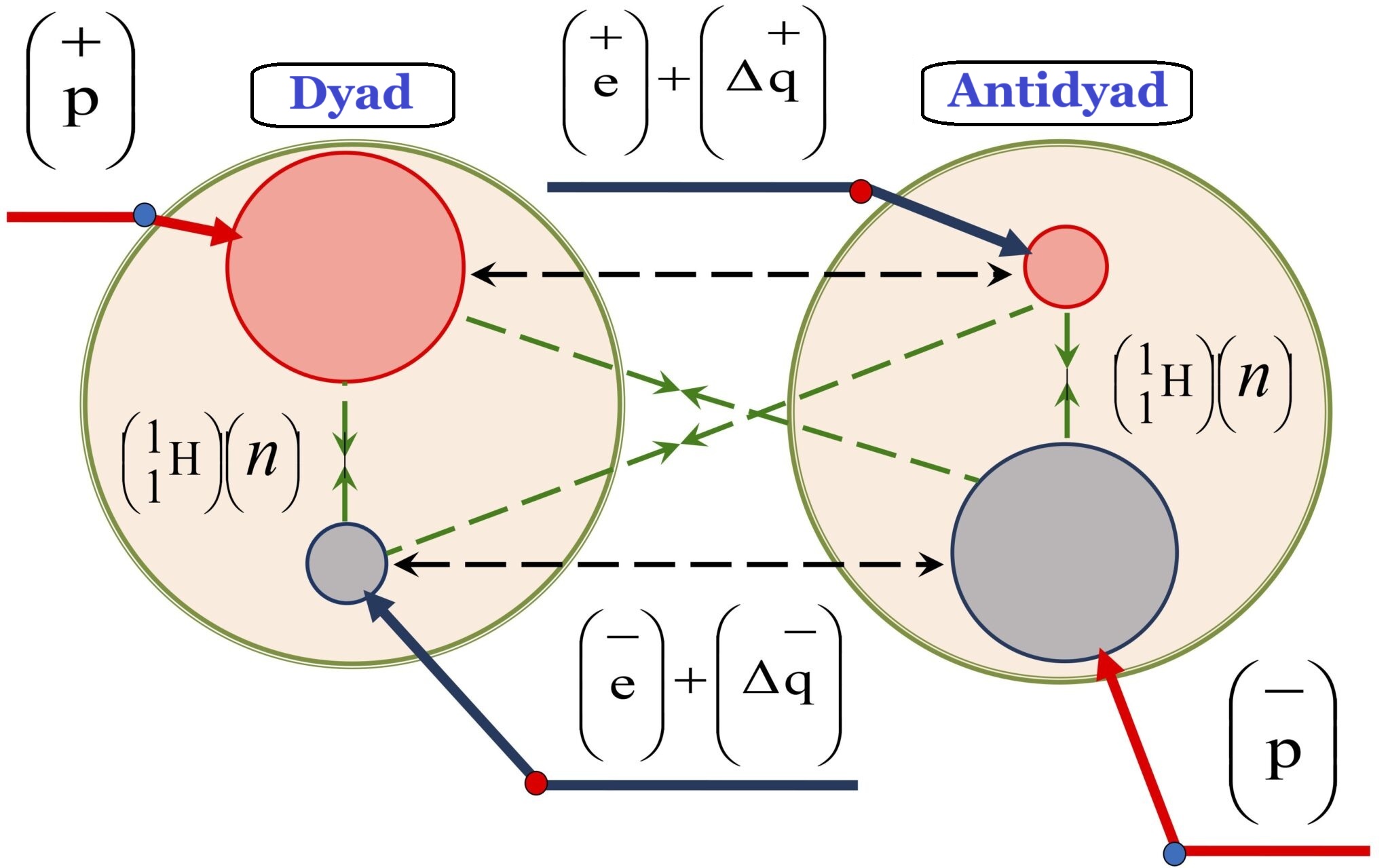
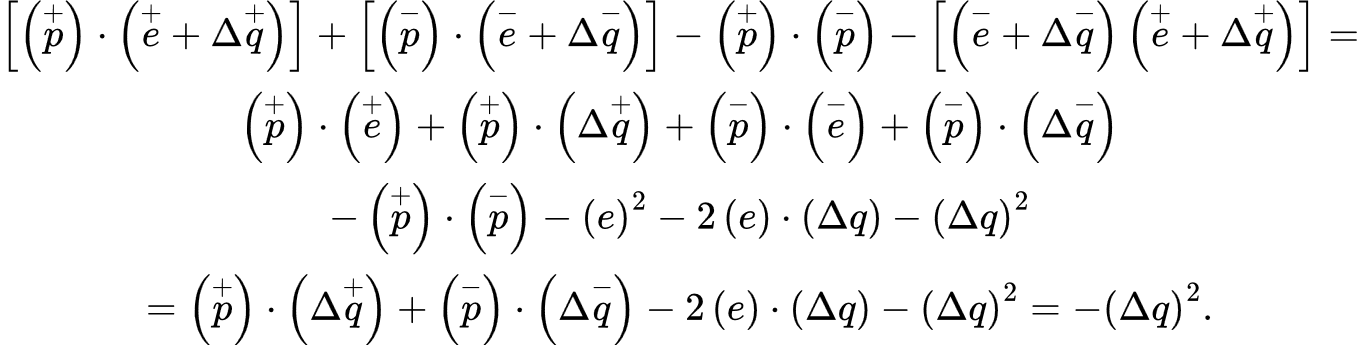
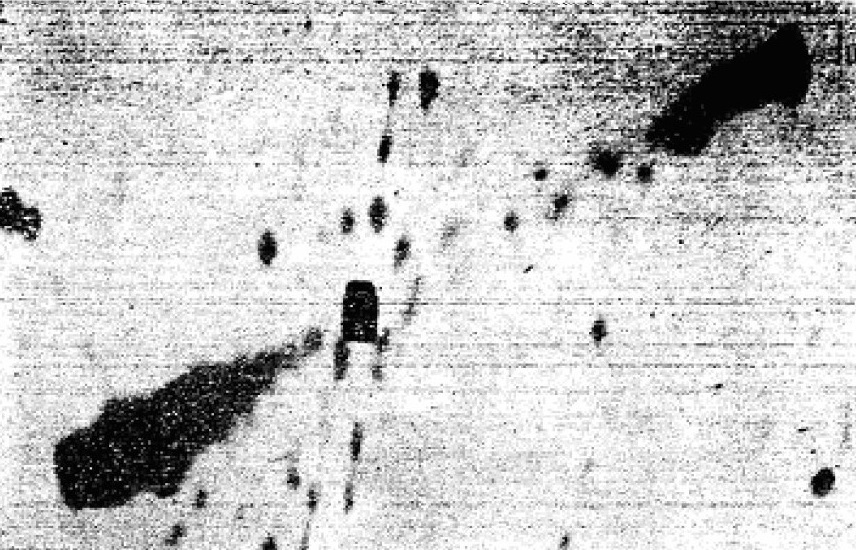
Therefore, in diametrically opposite directions from the quasar’s “D-body,” clouds of hydrogen are formed on one side, and clouds of antihydrogen on the opposite side. Anti-gravitating and condensing, these clouds form galaxies and anti-galaxies (Ambartsumian, Klein, Alfvén).
5. If substance and antisubstance in the Universe consist of micro-dyads:
\left({\overset{+}{p}}+{{\overset{-}{e}}}\right) and \left({\overset{+}{e}}+{{\overset{-}{p}}}\right),
then the laws of the Megaworld must be the same as the laws of the Microworld, i.e., Newton’s–Coulomb’s inverse-square law and the virial theorem (Clausius).
6. Newtonian gravitation did not explain the anomaly of Mercury’s orbit.
The motion of any celestial body rotating in an elliptical orbit around the center of mass (the Sun or a star), due to the inversely proportional distribution of centripetal and centrifugal forces, will gradually transform into circular motion as it approaches perihelion and aphelion. The shifts of perihelion and aphelion points, directed opposite to the planet’s motion, as well as Mercury’s elliptical orbit, have a very simple explanation:
- Mercury is on the closest orbit to the Sun and therefore has the highest orbital frequency. Since the Sun attracts all passing physical objects (large asteroids, comets, etc.), Mercury has the highest probability of collisions among all planets of the Solar System, thereby transforming its orbit into an elliptical one.
7. Since the values of “gravitational coefficients – G(nuclides)” (“Gravitation, weak and strong interactions”) for each nuclide are calculated using the formula:
G = C2× 10-7× | Δq × N |2
where N is the number of atoms in 1 kg of the nuclide,
which clearly has an electrodynamic nature, then the expression in brackets:
| Δq × N |2
is nothing other than the electrodynamic charge of one kilogram of the virial mass of a nuclide or anti-nuclide:
Σ (|Δq|(cl/kg)) =|Q|(cl/kg).
Therefore, the “gravitational” interaction is Coulombic for objects assumed to be “neutral,” composed of dyads also assumed “neutral,” but possessing an excess electrodynamic charge:
\left (\Delta\overset\pm{q}\right ) ≈ 1 ÷ 2 × 10-37(cl)
and an interaction force:

8. Thus, in Nature there exists a single fundamental force interaction of electrodynamic nature, obeying the inverse-square law:
F = \frac{c^{2}\times 10^{-7}\times \left| Q_{\left( 1 \right)} \right|\times\left| Q_{\left( 2 \right)} \right| }{r^{2}} .
9. Since the “gravitational” (i.e., Coulomb) interaction between cosmic objects was computed using the formula: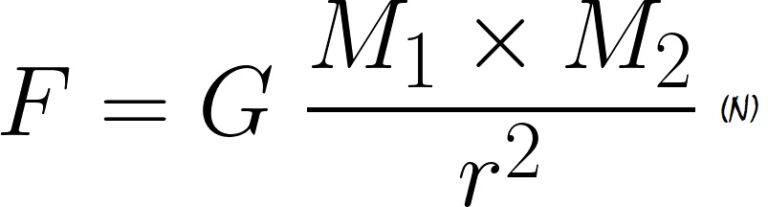
and G was determined on torsion balances (20) made of solid materials, the most accurate value known to the author is:
G = (6,67387\pm{0,00027})\times{10^{-11}_{(N{\cdot}m^2/kg^2)}}
(РЖФ,№1,2005 г.),
and the virial mass was determined by the formula:
m(r) = \frac{r\times{V^2}}{G}
where:
М(r) – is the mass within a spherical volume of radius r,
V(r) – is the rotation velocity at distance r,
G – is the gravitational constant.
And if the main mass is concentrated within a radius r, then outside this volume:
V \sim {\sqrt{r}} (17).
Thus, the virial mass of a cosmic object, according to the differential rotation formula, is inversely proportional to the gravitational constant. But since matter in the Universe consists of ~77.4% hydrogen and ~20.8% helium, and the gravitational coefficient computed by the author for protium is:
G(¦H) = 3,38331990152076 × {10^{-11}_{(N{\cdot}m^2/kg^2)}}
( Protium),
then the virial mass of hydrogen in the Universe is:
\frac{(6,67387\pm0,00027)\times{10^{-11}_{(N{\cdot}m^2/kg^2)}} }{{3,38331990152076}\times{10^{-11}_{(N{\cdot}m^2/kg^2)}}} ≈ 2
– twice as large as that computed using the most accurate constant for “solid-state” objects. The “contribution” from helium-4 is only 7%, plus cosmic dust, free protons and α-particles. Thus, the “mystery” of dark matter is resolved
10. Based on all the above, the conclusion follows: Newton’s theory of gravitation remains an exact fundamental law of Nature, which should be called the “Universal Law of Interaction,” since substance and antisubstance anti-gravitate relative to each other (13,43).
Voltaire on Newton.
“Voltaire, in the Philosophical Letters, begun in late 1727 – early 1728 while in England and completed upon returning home in 1732, was the first on the European continent to extol both Newton and Newtonianism. The French Judicial Chamber (‘Parliament’) immediately condemned the book to be burned as ‘seductive, contrary to religion, good morals and respect for authorities.’
In it, Voltaire writes:
*‘…the greatest of all was Isaac Newton; …for if true greatness consists in receiving from heaven a mighty talent and using it for self-education and the enlightenment of others, then a man like Mr. Newton, scarcely encountered once in ten centuries, is truly great, whereas all …politicians and conquerors, without whom no century has been spared, are usually nothing but illustrious villains. We honor those who rule minds by the power of truth, but not those who create slaves by force, those who have understood the Universe, not those who have disfigured it.’” ((2) page.14).
Summary
1. According to Newton’s theory, a body moves in flat space-time under the action of an external force of unknown origin (“I frame no hypotheses”) and an inertial force of equal magnitude directed opposite to the external force:
“From the inertia of matter it follows that every body is with difficulty moved out of its state of rest or motion. Therefore, the ‘innate force’ may very properly be called the ‘force of inertia’.”((2)page.25).
According to Einstein’s theory, a body moves in curved space-time without external force or inertial force, in accordance with Mach’s principle (with which N.N.Rozanov disagreed).
2. According to the author’s electromagnetic field theory (N.N.Rozanov), a body moves in flat space-time under the action of an external electromagnetic, Coulomb (20) or Ampère (57) force, and an internal force opposite to the external one — the inertial force inherent to the dyads of matter:
\left({\overset{+}{p}}+{{\overset{-}{e}}}\right)
i.e., a force determined by internal structure.
- Dear visitors, no registration is required to leave your comment.
- The set of mathematical formulas in the comments is edited in the “LATEX” system. A formula is opened with the word katex [in square brackets] and closed with /katex [in square brackets].
- If your comment contains a link, it is automatically sent to spam for verification. Without links, all comments are published without delay.