






© 2006
Аuthor – Rozanov Nikolai Nikolaevich
The translations of titles, articles, books, citations, and statements by scientists may not match the official translations word for word, if such translations exist.
Quasar – a quasi-stellar source of radio emission.
“Taking into account the distance to a quasar (Q), the radiation power of a typical (Q) is:
- in the radio range ~1043 erg/s ,
- in the optical range ~1046 erg/s ,
- in the IR range ~1047 erg/s ,
i.e. the radiation of a quasar exceeds the combined emission of all stars in a large galaxy by a factor of 10 3–10 4. For quasar 3C 273, X-ray emission of ~1046 erg/s was also detected.” (FES, Moscow: “Soviet Encyclopedia”, 1984).
“One of the fundamental properties of quasars is the variability of their radiation in the radio, IR, and optical ranges (the shortest time variation τ~1 hour).
Since the size of an object variable in brightness cannot exceed cτ, the dimensions of the quasar ≤ 4 × 10¹²m (i.e., smaller than the diameter of Uranus’s orbit). The physical nature of quasar activity has not yet been fully revealed.” ((20), p. 247).
“It is not excluded that the mechanism of energy release in quasars is associated with gas accretion onto a massive black hole.” ((17), p. 295).
“Academician V. A. Ambartsumian was among the first to point out the very important role of galactic nuclei in explaining radio emission and other manifestations of galactic activity. Therefore, quasars naturally fit into his concept. From this point of view, quasars may be considered ‘naked’ galactic nuclei, where, by means of an unknown mechanism, ordinary galactic matter is formed, and this process is accompanied by powerful explosions (note 1). In this case, it was precisely the idea of the importance of explosive, non-stationary phenomena that played a great heuristic role and gained wide recognition… At the same time, new discoveries are still not proof of Academician V. A. Ambartsumian’s hypothesis that stars and galaxies arise from hypothetical superdense D-bodies.” ((16), pp. 62–63).
“The main striking feature of quasars is the enormous power of energy release in combination with small dimensions. At the same time, the quasar phenomenon cannot be likened to a short-term explosion such as a supernova. Images of the brightest quasars can be found on old sky photographic plates. It turned out that even on century-old plates, some quasars can be identified, and their average brightness has not changed significantly.” … “From these and other data it follows that quasars ‘live’ for no less than 107 –108 years.” ((16), p. 63).
“The efficiency of converting matter into radiation is maximal for substance–antisubstance annihilation:
Е = 100%.
For nuclear fusion reactions it is less than 1%. Taking an average estimate
Е ≈ 30%,
we obtain for the quasar mass
М ≥ 108÷109 \bigodot М », ((16)стр.64)
(inertial mass, since the gravitational one is an electrodynamic charge (Author)).
“Since this mass is contained in a volume of characteristic size 1013– 1015m, one might naturally imagine a quasar as a single, continuous body – a giant super-star. However, super-stars are unstable.” ((16), pp. 64–65).
“Models of dense and extremely compact star clusters also cannot produce ‘quasar-like’ properties.” ((16), pp. 65–66).
“One of the most important characteristics of quasars – their powerful radio emission – was taken into account in the model proposed in 1964 by Academician V. A. Ginzburg. The emission of quasars indicates the presence of a large number of accelerated particles (mainly electrons)” (and an equal number of positrons (Author)).
“The basis of this model is the assumption of a single magnetoplasma body in which macroscopic motions – rotation and strong turbulence – occur.” ((16), p. 67). A relic of this period is the phrase with which, to this day, some observers begin (or end) their articles: “There exist three models of a quasar: a super-star (magnetoid, spinar), a dense star cluster, and a black hole.” It is better to acknowledge that there simply is no good model.” ((16), p. 68).
Cygnus A is located about a billion light-years away from us, and the energy emitted in the radio range is enormous – comparable to the radiation energy of a trillion Suns. Since then many radio galaxies have been discovered; in some the radio source is located at the center, but most have a two-lobe structure: two radio-emitting regions positioned on opposite sides of the visible galaxy and separated by up to 10 million light-years. (See Appendix 7) (note 2).
The radio emission emitted by the two lobes of radio galaxies (quasars (Author)) is of the so-called synchrotron type; it is produced by electrons in the material lobe (and by positrons in the antimatter lobe (Author)) moving in strong magnetic fields at speeds close to the speed of light. For electrons to reach such velocities they must somehow gain extremely high energy, and therefore it is customary to assume that the observed radio lobes consist of clouds of matter ejected from the nucleus of the central galaxy. Obviously such systems contain compact energy sources. Direct measurements have shown that radio source 3C 273 B (coinciding with the star-like object) itself consists of two lobes separated by only a few light-years, and from variations in quasar brightness it was established that the main energy source apparently has dimensions no larger than 1 light-year. How can a source so small emit as much light as hundreds of galaxies?”…
“In one of them, object OX 169, the X-ray brightness varies by a factor of 2–3 over a period of about 300 minutes; this means that the main energy source here must not exceed the size of the Solar System. Obviously quasars must contain some very compact and specific energy sources.” ((33), pp. 134–136).
Можно было бы продолжить приводить примеры супер мощности «Д-тел» квазаров, (согласно термина академика В.А.Амбарцумяна ((16)стр.63), тем более, что только в работе «Распределение квазаров во Вселенной и космологические модели» ((12)стр.29-40), исследована база данных на 23760 квазарах.One could continue giving examples of the super-power of quasar “D-bodies” (according to Academician V. A. Ambartsumian’s terminology ((16), p. 63), especially since the work “Distribution of Quasars in the Universe and Cosmological Models” ((12), pp. 29–40) studies a database of 23 760 quasars.
From the above in this section, two conclusions follow:
- The “D-bodies” of quasars are generators of radiation of colossal power of an unknown nature.
- These generators occupy an anomalously small volume in space relative to the emitted power.
In work (12) by Zhuk N. A., Moroz V. V., Varaksin A. M., the distance to galaxies and quasars is determined by the formula:
V = V(0) ×ℓ^{-(r/R_{0})} (eq.19),
where
r = R(0) × ℓn (1+Z) ((eq.20),2),
and
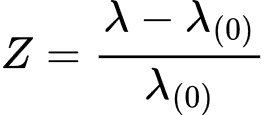
– is the redshift of the emission spectrum.
Law (eq.19) is fully confirmed by observations. These circumstances provide a strong argument for determining distances to distant cosmic objects, including quasars, using formula (20), rather than the traditional Big-Bang-model formula
r(t) = r(0) × R(t),
(R – scale factor)
H(t) = \frac{1}{R}×\frac{dR}{dt}
where H(t) is the Hubble constant (FES, p. 836).
3.

((11)p. 54).
R(0) ≈ 2,3 × 10 28(m)
((11)p. 55).
As comparisons show, the difference between the results of these calculations, for Z > 4, reaches 100% or more. Obviously, the choice of a formula for determining distances to distant cosmic objects must strongly influence our general ideas about the structure and properties of the Universe ((12), p. 33).
“Thus, the second method of determining quasar distances, and the theory of an expanding Universe from which this method follows, must be considered erroneous, not corresponding to the laws of physics and to observed natural phenomena.” ((12), p. 39).
The authors of (12) also present a portion of Table 1, in which values of r for 23 760 quasars were calculated:Также, авторы (12) предлагают фрагмент Таблицы 1, в которой вычислены значения – (r) для 23760 квазаров:
1. Using the formula:
r = R(0) × ℓn (1+Z)
– within the stationary cosmological model (R(0)=1), i.e., all distances measured in radii of gravitational interactions.
2. And using the formula:
R(0) =\frac{(1+Z)^2-1}{(1+Z)^2+1}×\frac{C}{H}
– within the Big-Bang concept, where the Hubble “constant” was increased by
\sqrt{2}
((12)p. 34).
Then the authors give distribution data for quasars in regions 1 and 2, confirming that quasars are uniformly distributed in the Universe, and that the Universe itself is stationary.
“This is evidenced by the fact that the most distant quasars are observed at distances of 30–35 billion light-years (and the most distant one with Z = 9 at 46 billion (!) light-years), which contradicts the 12–15 billion-year age of the Universe in the standard cosmological model.” ((12), p. 37).
Thus in work (12) the redshift is explained by dissipation of photon energy during propagation over great distances in the Absolute Physical Vacuum (APV (4)), whose inertial mass of particles is:
μs = \frac{\hbar}{{R_0}\cdot{C}}
Substituting R(0)~1026(m), yields μs ~ 10-69(kg) ((11), p. 56).
Approximately the same value is obtained for the APV(4) particle – the “polar” in Kolpakov’s theory:
μs = ~ 10-69(kg)
((11)p. 58),
i.e. the APV is not empty (4).
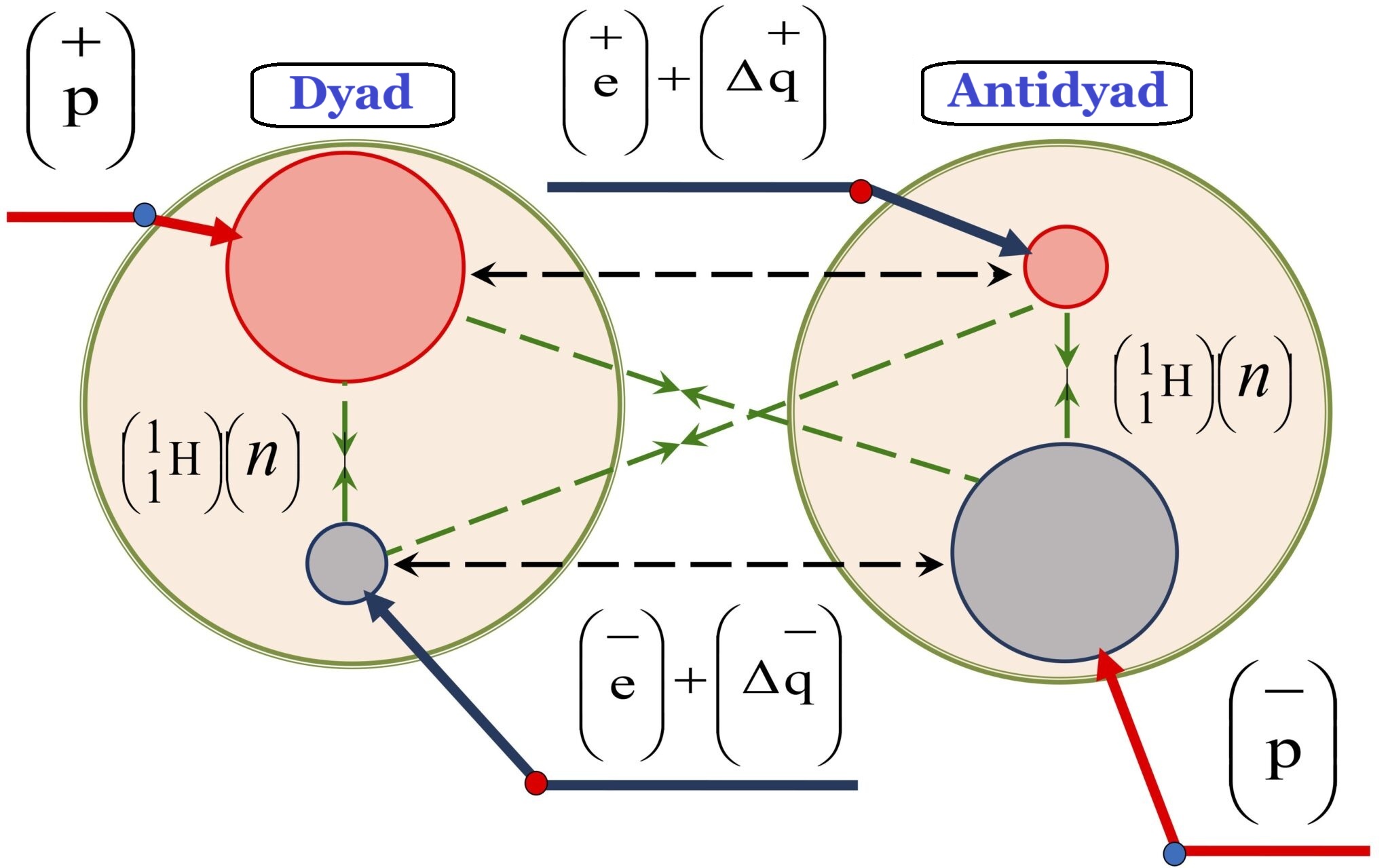
Quasars do not interact “gravitationally” with each other (neither attract nor repel). This phenomenon is possible only if the number of dyads and anti-dyads in quasars is equal:
\sum\left({\left({\overset{+}{p}}\right)}+{\left({\overset{-}{e}}\right)}\right )=\sum \left({\left({\overset{-}{p}}\right)}+{\left({\overset{+}{e}}\right)}\right).
Then:
\left|\sum\times \ \Delta\overset{-}{q}\right| = \left|\sum\times \ \Delta\overset{+}{q}\right|
i.e.:
\left( \sum\times\ \Delta\overset{-}{q} \right) + \left( \sum\times \ \Delta\overset{+}{q} \right) = 0.
However, the “lobes”, or sides of the “bow-tie”,

clearly anti-gravitate, which is possible only if one lobe is made of matter and the other of antimatter, where:
\left| \Delta\overset{-}{q}\right| \times \left|\Delta\overset{+}{q}\right|
is the deficit of attraction between proton and antiproton, dyads and anti-dyads of the lobes:

In work (13) H. Alfvén writes:
“However, it is difficult to find a process capable of separating ambiplasma in quantities sufficient to form an entire galaxy of pure matter or pure antimatter. In particular, the separation of ambiplasma on such giant scales requires transporting matter and antimatter particles in opposite directions over enormous distances. Estimates based on reasonable choices of forces and characteristic times show that apparently no conceivable transport mechanism can cope with such a task. However, this does not mean that separation of ambiplasma on galactic scales is impossible altogether.” ((13), p. 93).
“In Chapter V (section 6(b)) we established that the criterion of symmetry of matter and antimatter will be satisfied if every second galaxy consists of antimatter” … “However, it seems plausible that ambiplasma separation is closely related to the formation of galaxies.” ((13), p. 94).
The author of the present work (N.N.Rozanov) asserts that the mechanism of separating ambiplasma into matter and antimatter is anti-gravity (43) between dyads of matter and anti-dyads of antimatter, born in the quasar’s “D-body” ((19), p. 63) and having “escaped” annihilation in ambiplasma composed of particles and antiparticles ((13), pp. 59–63). Since particles and antiparticles (including photons emitted into the Universe) are created in pairs from the primary torsion field ((3), pp. 135–151; (9), p. 91), and the magnitudes of elementary electric charges are exactly equal (otherwise the Universe would be electrically charged), the probabilities of collision between electrons and positrons, protons and antiprotons, electrons and protons, and positrons and antiprotons in ambiplasma are 50×50%. Therefore, ~50% of the created particles annihilate into γ-quanta and must be emitted into space, or, in an inelastic collision with another γ-quantum, create a new particle–antiparticle pair. And 50% of the created particles and antiparticles can form dyads of matter and antimatter:
\left (\overset{\pm}{p}+\overset{\mp}{e}\right),
whose particles, according to Clausius’s virial theorem (36), must orbit their common center of mass at relativistic speeds (see examples 1–8). As a result, an excess electrodynamic (magnetic) charge arises:
|Δq| ≈ 1÷2 × 10-37(cl),
per dyad—this excess charge is “gravitational”. But since the number of dyads and anti-dyads in the Universe is exactly equal, the Universe as a whole remains electrically neutral. Dyads and anti-dyads anti-gravitate due to the deficit of attraction between proton and antiproton equal to:
\left( \Delta\overset{-}{q} \right) \times \left(\Delta\overset{+}{q} \right) = \Delta{q}^{2}.
The separation of dyads and anti-dyads is the mechanism of ambiplasma division into matter and antimatter, answering Alfvén’s question about the cause of differentiation ((13), pp. 89–94). Dyads and anti-dyads “fly apart” in diametrically opposite directions and form the “lobes” of the bow-tie ((1), p. 38) made of matter and antimatter.
Thus clouds of primordial hydrogen and antihydrogen are formed (possibly with some helium), which, upon condensation, give rise to galaxies and anti-galaxies.
Законы классической механики и о якобы невозможности их применения в расчетах небесной механики
Next chapter >>>>
[1] Substance \left( диады\left (\overset{+}{p}+\overset{-}{e}\right) \right) can be formed only together with antisubstance \left(антидиады\left (\overset{-}{p}+\overset{+}{e}\right) \right), which separate from each other through mutual repulsion (Author).
[2] The author of the present work believes that all quasars possess a two-lobe structure, but some of them are oriented with their “lobes” along the line of sight.
- Dear visitors, no registration is required to leave your comment.
- The set of mathematical formulas in the comments is edited in the “LATEX” system. A formula is opened with the word katex [in square brackets] and closed with /katex [in square brackets].
- If your comment contains a link, it is automatically sent to spam for verification. Without links, all comments are published without delay.